

A hook is whatever makes someone stop scrolling in the first one to three seconds of a Reel, TikTok or Short. It has three layers that work together: what you say, what the text on screen says, and what the first frame shows. Most hook lists only cover the first one. The best hooks line up all three around one idea, then deliver on the promise fast.
Below are 40 hooks you can adapt, grouped by type, plus how I design the visual side, how to measure a hook and how to test them. I've been making short-form for sneaker, food, luxury and local brands since the early Instagram days, from Kicks USA to Gopuff to Luxury Bazaar, and the visual hook is where most videos are won or lost.
Why the first three seconds matter so much
Every feed is a stream of choices made in a fraction of a second. If the first moment of your video doesn't give someone a reason to stay, the rest of it doesn't exist for them. In January 2025, Instagram's head Adam Mosseri named the three signals that matter most for ranking: watch time, likes and sends. You can't build watch time on a video people leave in second one.
The goal of a hook isn't to trick people into staying. It's to make a clear promise that the rest of the video keeps. A hook that overpromises gets the stop and loses the watch.
The three layers of a hook
The spoken hook: the first sentence out of your mouth (or the voiceover).
The text hook: the words on screen, which most people read before they hear anything, because a lot of viewers watch with the sound off.
The visual hook: what's in the first frame and what moves in the first second.
When all three point at the same idea, the hook hits harder. When they fight each other (a calm talking head, a busy caption and a different topic in the text), people don't know what the video is about and they leave.
40 hooks for Reels and TikTok
Fill in the brackets with your topic. Each one works best when you start the video on the hook, with no intro, logo or "hey guys."
Curiosity hooks
1. "Nobody talks about this part of [topic]."
2. "I tried [thing] for [time] so you don't have to."
3. "This is why your [thing] looks [problem]."
4. "Wait until you see the last one."
5. "The [thing] that changed how I [do something]."
6. "There's a reason every [type of brand] does this."
7. "This [ordinary object] costs more than you think."
8. "I wasn't supposed to show you this."
Mistake and warning hooks
9. "Stop doing [common habit] if you want [result]."
10. "The [number] [thing] mistakes I see every week."
11. "If your [thing] looks like this, fix it today."
12. "Don't buy [thing] until you watch this."
13. "You're [doing thing] wrong, and it's costing you [result]."
14. "I made this mistake for [time]. Here's what fixed it."
Value and how-to hooks
15. "How to [result] in [short time] with [simple tool]."
16. "[Number] ways to make your [thing] look expensive."
17. "Save this for your next [event or task]."
18. "The [number]-step [thing] I use for every client."
19. "Here's the exact [setting, template or setup] I use."
20. "Steal this [thing] for your brand."
Before and after hooks
21. "Same [thing], [number] minutes apart."
22. "Day 1 vs. day [number]."
23. "What the client sent vs. what we made."
24. "[Cheap version] vs. [expensive version]. Can you tell?"
25. "Watch this [thing] go from [bad] to [good]."
Story hooks
26. "A [type of customer] walked in and asked for [unusual thing]."
27. "This started as a [small thing] and turned into [big thing]."
28. "I almost didn't post this."
29. "Here's what happened when we [did something bold]."
30. "[Time] ago I was [past situation]. Now [current situation]."
Product and local business hooks
31. "POV: you just found the best [product] in [city]."
32. "Things in our shop that sell out every time."
33. "How we make [product], start to finish."
34. "The [product] our regulars won't shut up about."
35. "Rating every [product] we sell, honestly."
36. "If you're in [city], you need to try this."
Opinion and debate hooks
37. "Unpopular opinion: [take]."
38. "[Popular thing] is overrated. Here's why."
39. "Which one would you pick?"
40. "Tell me you're from [city] without telling me."
How to design the visual hook
This is the part the hook lists skip, and it's where a designer earns their keep. Before anyone hears a word, they see a frame. Treat that first frame like a YouTube thumbnail: it has to make sense at a glance, on a small screen, with the sound off.
Start mid-action
Open on movement, not on a still setup. A hand dropping the product, a pour, a shoe hitting the pavement, a reveal already halfway done. Movement in the first half-second catches the eye before the brain decides to scroll.
Make the first frame a picture, not a person getting ready
Cut the breath, the smile and the "so." Start on the most interesting frame you have, even if it's from the middle of the video, then show how you got there.
Use a pattern break
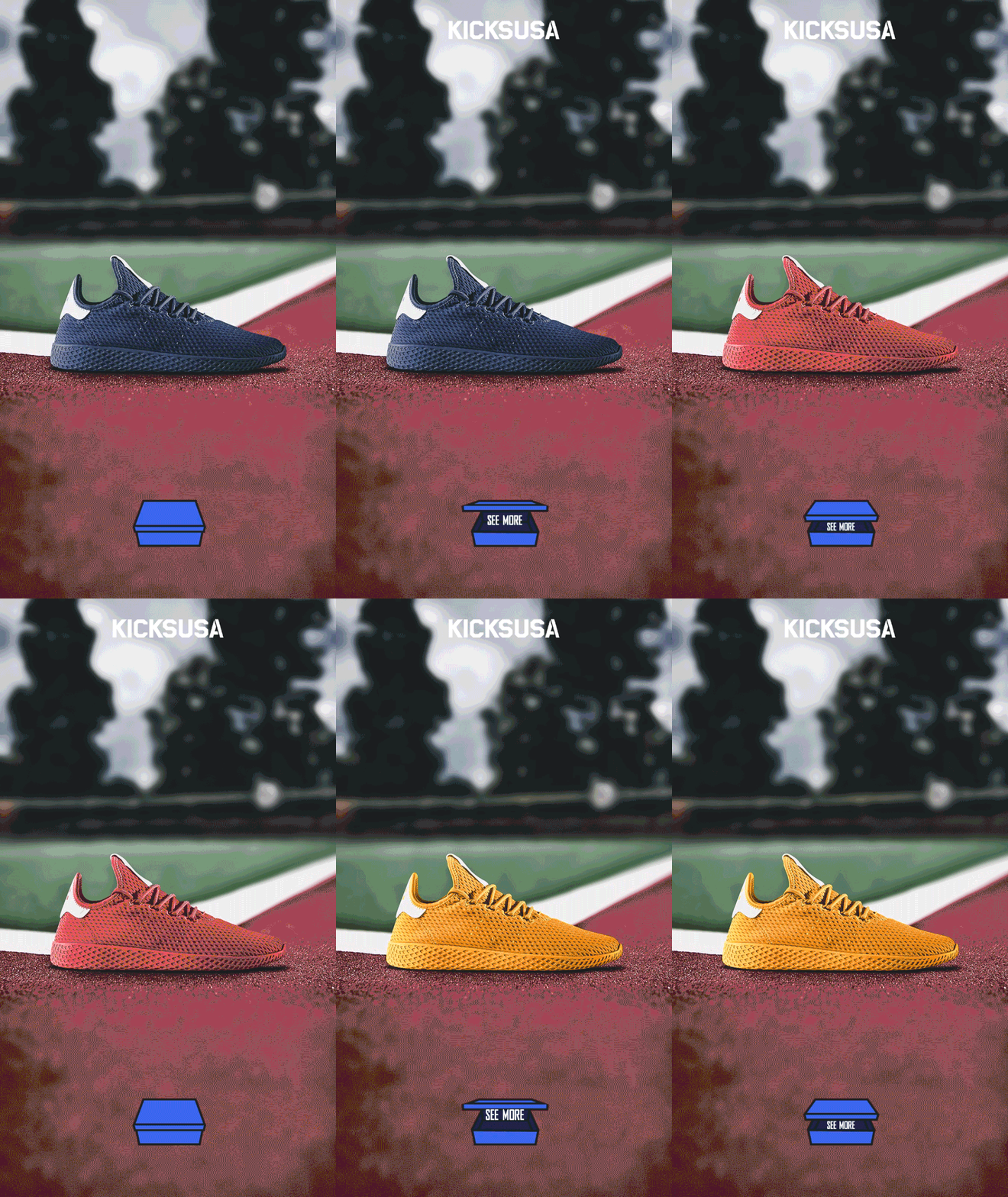
Something that doesn't look like the rest of the feed: an unusual angle, an extreme close-up, a bold color, a strange object, a frame that's mostly empty. At Kicks USA, the stories that worked best used a single product in a bold, simple scene instead of a busy store shot.
Design the on-screen text
The text hook is a design job:
Short. 3 to 8 words. It should be readable in about a second.
Big and bold. If you have to squint at it on a phone, it's too small.
High contrast. Light text with a dark outline or shadow, or text on a solid shape. Never thin text over a busy background.
In the safe zone. On a 9:16 video, the top and bottom are covered by the app's buttons and captions. Many teams keep text out of roughly the top 14% and bottom 35% of the frame, and away from the right edge where the like and share buttons sit.
On screen from frame one. Not faded in after two seconds. The first frame needs the text already there.
Consistent. Same font, color and position across your videos. Your audience learns to recognize your posts before they read them.
Match the sound to the cut
If you use music, cut the first visual change on a beat. If you're talking, start mid-sentence or on the punchiest word. Silence at the start reads as dead air.
What is hook rate?
Hook rate is the share of people who see your video and keep watching past the first few seconds. On paid social it's usually calculated as 3-second video plays divided by impressions. Organic platforms don't always show it under that name, but you can find the same idea in Instagram's and TikTok's insights: look at how many viewers drop off in the first seconds of the retention graph, and at average watch time.
Hook rate tells you if the start works. Hold rate (how many make it to the middle or end) tells you if the rest of the video keeps the promise. You need both: a great hook with a weak middle just wastes people's attention faster.
How to test hooks
You don't need fancy tools. You need the same video with different starts.
Change one layer at a time. Same video, different first frame. Or same video, different on-screen text. If you change everything, you won't know what worked.
Make 2 to 3 versions of the first 3 seconds. Editing a new opening is fast once the body of the video is done.
Post them at different times, or run them as ads. On paid social you can put each version in the same ad set with a small budget and compare 3-second plays per impression.
Keep a hook log. A simple sheet: hook type, first frame, text, hook rate or drop-off, average watch time, shares. After 15 to 20 videos you'll see which hook types your audience reacts to.
Reuse the winners. A hook that works is a format. Make it a series.
Common hook mistakes
Starting with a logo, an intro or "hey guys, welcome back"
On-screen text that's too small, too long or under the app's buttons
A hook that promises something the video never delivers
Three different ideas in the first three seconds
Copying a trending hook that has nothing to do with your product
Making the hook the only good part of the video
Hooks FAQ
How long should a hook be?
One to three seconds. If it takes longer than that to get to the point, it isn't a hook yet.
Should I use the same hook on TikTok, Reels and Shorts?
Usually yes, with small changes. Check each app's safe zones so your text isn't covered, and match the native style of each platform.
Do hooks work for ads too?
Yes, and paid social is where you can measure them best. Ads with a clear hook in the first frame usually outperform ads that open on a logo. See my guide to ad creative that converts for more.
What's a good hook rate?
It depends on the account, the audience and the platform. Compare your videos against each other rather than chasing a single number, and look for the hooks that consistently beat your own average.
Can I write hooks with AI?
AI tools are fine for brainstorming hook ideas. The visual hook, the edit and knowing what your audience actually responds to still come from testing and taste.
Want short-form that stops the scroll?
I plan, shoot, edit and design short-form video and the text and thumbnails that go with it for brands and creators in Philadelphia and beyond. See the work on my social media content page, or start a project.